I Don’t Know How to Relax: What Is Active Relaxation? (And Why Relaxation Doesn't Have to Mean Sitting Still)
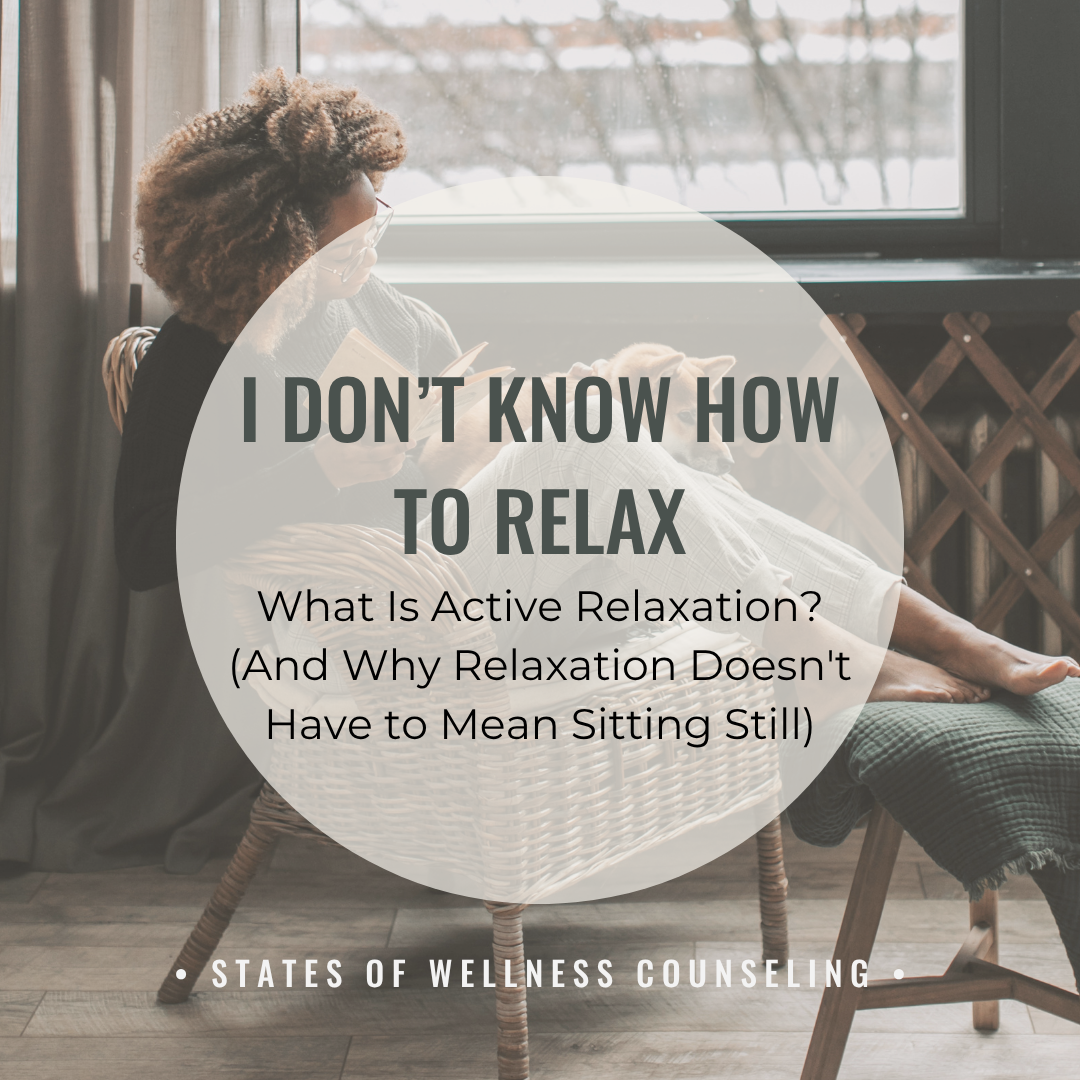
If you feel you don’t know how to relax, recognizing the role active relaxation plays in your life can be helpful.
Relaxation may feel hard for you because you are equating it with “doing nothing.” For many people, they think of relaxation as lying down on the couch, reading a book, or sitting still. And while relaxation can absolutely be any of those things, relaxation is not limited to stillness.
In fact, focusing solely on that type of relaxation limits what could actually be truly restorative for you.
It can also feel difficult to relax because you feel guilty when you are not being productive. We live in a very go go go society and are often receiving messages about productivity, multitasking, and that you must “earn your rest” (not true).
When we live this way most of the time, our nervous system does not understand how to turn that “go go go” mentality off. We exhaust ourselves until we simply lean into passive leisure activities like scrolling, watching TV, or even scrolling while watching TV.
Passive leisure in moderation isn’t bad, it’s just not always restorative. That may be why after you engage in passive leisure you’re like, “what’s wrong with me? Why can’t I just relax?” It may be that your nervous system didn’t get what it needed to fully relax.
What does it mean to relax?
I find that definitions can help us step outside the connotations we attach to a word. What does relax actually mean? Merriam-Webster says to relax is “to seek rest or recreation.”
If we follow the trail, we will also see that rest is defined as the following:
to cease from action or motion
refrain from labor or exertion
to be free from anxiety or disturbance
And that recreation is defined as:
something people do to relax or have fun
activities done for enjoyment
So, we see here that relaxation can indeed involve stillness but it is not limited to such.
What is active relaxation?
Active relaxation is the practice of using intentional activities that feel calming, enjoyable, and restorative while gently engaging your body and attention.
Your cup feels fuller. Your soul is a bit more fueled. Even better if these activities are somehow connected to your value system. You can feel your nervous system exhale. You’re present in your own life.
Examples of active relaxation
It’s important to remember that what exists as active relaxation for one individual, may be different than what active relaxation is for you. The key is that it’s an activity that you do mindfully.
Outdoors:
Taking a walk
Going for a hike
Gardening (weeding, watering, checking on your plant babies)
Creative:
Sewing/Knitting/Crochet
Painting
Cooking/baking
Playing music
Movement:
Gentle yoga
Stretching
Dancing to some music
Mindful:
Journaling
Working on a puzzle
Doing your nails
Home & Maintenance*
A project you’ve been wanting to work on
Yardwork that’s enjoyable
Low stakes cleaning that feels restorative
*Watch out for sneaky productivity guilt here. These should be items that you want to do in an enjoyable, mindful way.
How to know what is relaxing to you
One of my favorite things to do with clients is to simply pay attention to how they describe their “good” days. The days they felt truly content and at peace. I listen for what activities they engaged in that day and what made something enjoyable.
And in all the years of working with clients, I can honestly say the common denominator has always been slowness, presence. There was space for existing. Space for spontaneity. Space for simply being and engaging in things that can often get pushed aside.
Do this for yourself. Pay attention to how different activities make you feel. What feels restorative to you? What has contributed to the days you feel content?
You can ask yourself:
Do I feel calmer afterward?
Do I feel more like myself?
Am I doing this intentionally or just by default?
Do I leave feeling more energized or more depleted?
Once you learn this about yourself, you can learn to intentionally turn to those activities. Over time, this becomes your active relaxation.
Want support like this in your inbox?
If this resonated with you, you’re not alone. I send out practical, down-to-earth tools like this in my newsletter, along with reflections on anxiety, stress, and how to make everyday life feel more manageable.
You can join my newsletter here.
About the author:
Hi, I’m Shannon. I am a psychotherapist who works with Millennial and Gen Z women navigating anxiety and overwhelm. I help them reconnect with what truly matters in their lives by slowing down, recognizing their values, and learning to retrain their brains towards wellness.
If you are in Illinois or Wisconsin, connect with me to see if we may be a good fit to meet your needs and goals. You can also check out my full website to learn more.

